
Newport Beach City Directory Collections
The strongest starting point is the Newport Beach Public Library Central Library Local History Collection, followed by the California State Library California History Section and Sherman Library. The State Library’s Newport Beach Research Guide directs researchers to its directory and Telephone Books databases, while National Archives holdings confirm selected Orange County volumes that include Newport Beach and nearby communities.
| Collection | Verified years | Where held or sourced | Access |
|---|---|---|---|
| Orange County volumes including Newport Beach, Balboa, and Corona del Mar | 1926, 1929, 1931 | National Archives holdings; State Library catalog may add runs | Catalog-specific or onsite consultation |
| Local city and telephone samples | 1920-1926, 1946, 1950, 1955, 1965-66, 1970, 1975, 1980, 1986, 1991-92, 1995, 1997, 2001-02 | City environmental historical assessments citing publishers | Reports online; underlying volumes need shelf confirmation |
| Local newspapers | 1940s to early 2000s | Newport Beach Public Library microfilm and digital collections | Library access and staff assistance |
| Sanborn fire-insurance map | May 1922 | Library of Congress, Newport Beach, Balboa, and East Newport sheets | Free public-domain images |
| Federal census households | Public through 1950 | National Archives, Ancestry, and HeritageQuest | Free NARA access or library databases |
| Sherman coastal archives | 1912-1924 marshal records; 1940s-50s fire and police material | Sherman Library & Gardens finding aids | Reference or appointment conditions |
These are verified samples, not an exhaustive continuous run. The research record does not provide an official catalog export proving that every year or publisher is held in one place. Ask library or archive staff to confirm a shelf, reel, scan, or catalog record before planning around a missing year.
The Newport Beach Directory Timeline
Publisher changes affect how a volume reads. Early volumes may combine names, listed trades, and addresses. Telephone companies later emphasized subscribers and numbers. Reverse or Haines-style products changed the search direction again. A timeline helps explain why two volumes with the same city label do not offer the same fields.
| Period or sample | Publisher or source noted | Research value |
|---|---|---|
| 1920-1922 | Santa Ana Directory Company, Western Directory Company, Kaasen Directory Company | Early local and Orange County name and address conventions |
| 1925-1931 | Directory samples and NARA Orange County holdings | Balboa, Balboa Island, Newport Beach, and Corona del Mar headings |
| 1946-1955 | Telephone and local directory samples | Postwar address and subscriber continuity |
| 1965-1986 | Pacific Telephone, Southern California Telephone Company, General Telephone, Luskey Brothers and Company | Publisher changes and reverse-address potential |
| 1991-2002 | Ross Publications, Pacific Bell, Haines Company, and other sampled sources | Later directory and telephone-book comparisons |
The sampled record reaches from 1920 to 2002, but gaps remain. A missing volume can reflect incomplete local holdings, a publisher change, or a research report that sampled rather than listed every year. Treat the table as a research map, not a promise that a continuous Newport Beach directory run exists.
From Santa Ana Directory Company to Haines
Santa Ana Directory Company, Western Directory Company, and Kaasen Directory Company appear in the early samples. Later records name Pacific Telephone, Southern California Telephone Company, General Telephone Company of California, Luskey Brothers and Company, Ross Publications, Pacific Bell, and Haines Company. The change is more than a label. It can move a researcher from an alphabetical household index to a subscriber list or a street-order reverse section.
Record the publisher exactly as printed, along with the title page, locality heading, and abbreviation key. A telephone book may show only a subscriber. A volume may list a spouse, address, and business or trade line. A reverse volume can start with a street or telephone number. Those differences matter when a family name disappears but an address remains.
Newport Beach’s surrounding communities also shift the search. Search Orange County volumes, then repeat with Balboa, Balboa Island, Corona del Mar, East Newport, and Newport Harbor. Directory coverage follows the source’s chosen geography, not always the current city boundary.
Reading a Newport Beach City Directory Entry
A directory entry is a compact index record. The name line may include a surname, given name or initial, spouse in parentheses, a listed trade or business line, and a home address. Marks such as “h” for home, “r” for rooms or resides, and “wid” for widow can carry family-history meaning. Telephone books often narrow the result to subscriber name, address, exchange, and number.
| Name line | Surname, given name or initial, and sometimes a spouse in parentheses. |
|---|---|
| Listed affiliation | A trade, business, or civic connection that helps distinguish people with the same name. |
| Address | House number and street, with locality wording that may differ by year. |
| Residence mark | Publisher abbreviations such as “h” or “r,” interpreted with the key. |
| Family notation | Parenthetical spouse or “wid” wording that can guide a family-history search. |
- Criss-cross directory
- An address-first section that reverses the name index and can reveal a printed occupant or subscriber at a street location.
- Householder index
- A name-oriented listing for a principal household member, not a complete list of everyone connected to an address.
- Abbreviation key
- The publisher’s explanation of short marks. Photograph or transcribe it before reading a run.
- Subscriber listing
- A telephone entry tied to a service account. It is not proof of every person who used the address.
When a historical entry needs a current parcel bridge, the Newport Beach street directory by address can connect an old street line to modern GIS and APN research without rewriting the old entry.
Follow 3300 Newport Boulevard Through Years
The city’s environmental historical assessment gives a safe address-oriented sample. 3300 Newport Boulevard appears as Newport Beach City Hall in 1950, 1955, 1966, and 1980. Nearby 3305 Newport Boulevard is listed as Les Coiffures in 1966, Hair West in 1970 and 1975, and Hair West Haircutters in 1986. A separate 3531 entry shows a Chevron service operator in 1966, 1975, and 1980.
The sample inventory contains year, street address, occupant or business, and source or publisher. It demonstrates continuity and name changes without treating a commercial address as a private household record. It also shows why an address search should preserve the printed use and source instead of collapsing every entry into one name.
For family history, repeat the same method with a known residential address, then compare adjacent years. For property curiosity, pair the entry with a Sanborn footprint, permit chronology, or parcel map. If a directory line does not match a modern address, search the locality name and legal description before deciding that the record is wrong.
Alphabetical and Criss-Cross Searches
Start with the alphabetical section when a surname is known. Read the street-order or criss-cross section when an address is known. Compare both when possible. Name variants, initials, compound surnames, spouse names, trusts, family LLCs, and “Estate of” entries can change the filing position. A clean search keeps the exact spelling and the source year.
Use the address section to test continuity, not to assume that one printed line represents every occupant. A telephone subscriber may be absent after a service change. A household member may not appear in the name section. A one-year gap may be a missing volume or a move. Newspapers, obituaries, probate records, and census households can help separate those possibilities.
The reverse method is especially useful for a house-history project. Write down each name, mark, and address before moving to another year. That creates an audit trail that can be checked against the library’s catalog, a deed citation, or an official public-record file.
Pair Newport Beach City Directories with Census
Federal census schedules through 1950 are public under the 72-year rule. Directory years sit between those decennial snapshots, so a name and address can help locate a household before the matching census is opened. Compare the directory’s name, spouse mark, locality, and address with a census household, then note differences in age, relationship, and listed trade.
- Choose a known person, address, or approximate year and identify the closest directory volume.
- Read the title page and abbreviation key, then record the exact entry and any locality heading.
- Check the nearest 1920, 1930, 1940, or 1950 census household through NARA, Ancestry, or HeritageQuest.
- Compare the next directory sample and keep moves, spelling shifts, and household changes separate.
- Use newspapers, obituaries, probate, deeds, or yearbooks to close a gap rather than filling it by assumption.
Newport Beach geography requires care. Balboa Island and Newport Heights joined in 1917, Corona del Mar in 1924, and later coastal areas have their own development eras. Search the community printed on the source before applying a current city or ZIP label.
Where Newport Beach Directory Volumes Live
Newport Beach Public Library Central Library, 1000 Avocado Avenue, has an upper-level Local History Collection with books, photographs, and rare local and Orange County material. Use is in the library with staff assistance. The library’s local newspaper historical collection spans the 1940s to early 2000s on microfilm and digitally. Its database page supplies in-library Ancestry Library Edition, HeritageQuest, NewsBank with Orange County Register and Daily Pilot, and Los Angeles Times Historical reaching back to 1881.
Newport Beach Public Library special collections describe the local-history shelf and partner materials. The collection lead is useful when a city directory is not indexed on the open web.
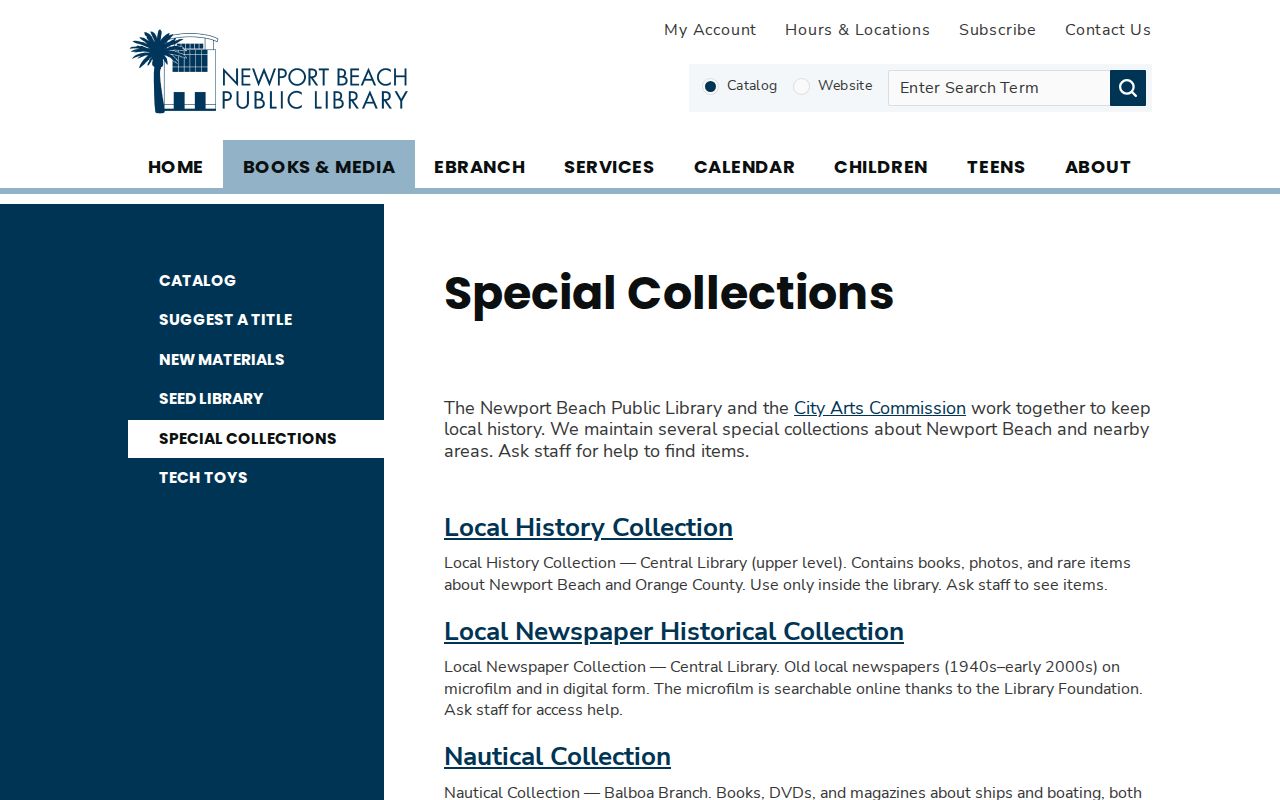
The library image belongs with the access path because staff help, microfilm readers, and local holdings can fill a year that is absent from a broad online search.
The California State Library Newport Beach guide points to City Directories and Telephone Books searches for “Newport Beach.” NARA supplies directory holdings and catalog context. Sherman Library & Gardens archival collections document coastal Southern California development, while Balboa Island Museum and Newport Beach Historical Society add local objects, photographs, and community history. Access may require a catalog request, finding aid, reading-room visit, appointment, or staff reference help.
Newport Beach Directory Holdings at NARA
National Archives directory holdings show Orange County volumes containing Balboa, Balboa Island, Newport Beach, and Corona del Mar for 1926 and 1929, with another Orange County entry shown for 1931. The holdings are evidence that Newport Beach appears inside broader county directories, not proof that every year is held in one local shelf. Catalog and onsite access rules control the next step.
National Archives city-directory holdings provide the verified county-volume lead. Search the county and community wording shown by the catalog, then ask a reference librarian whether a scan, microfilm copy, or partner database is available.
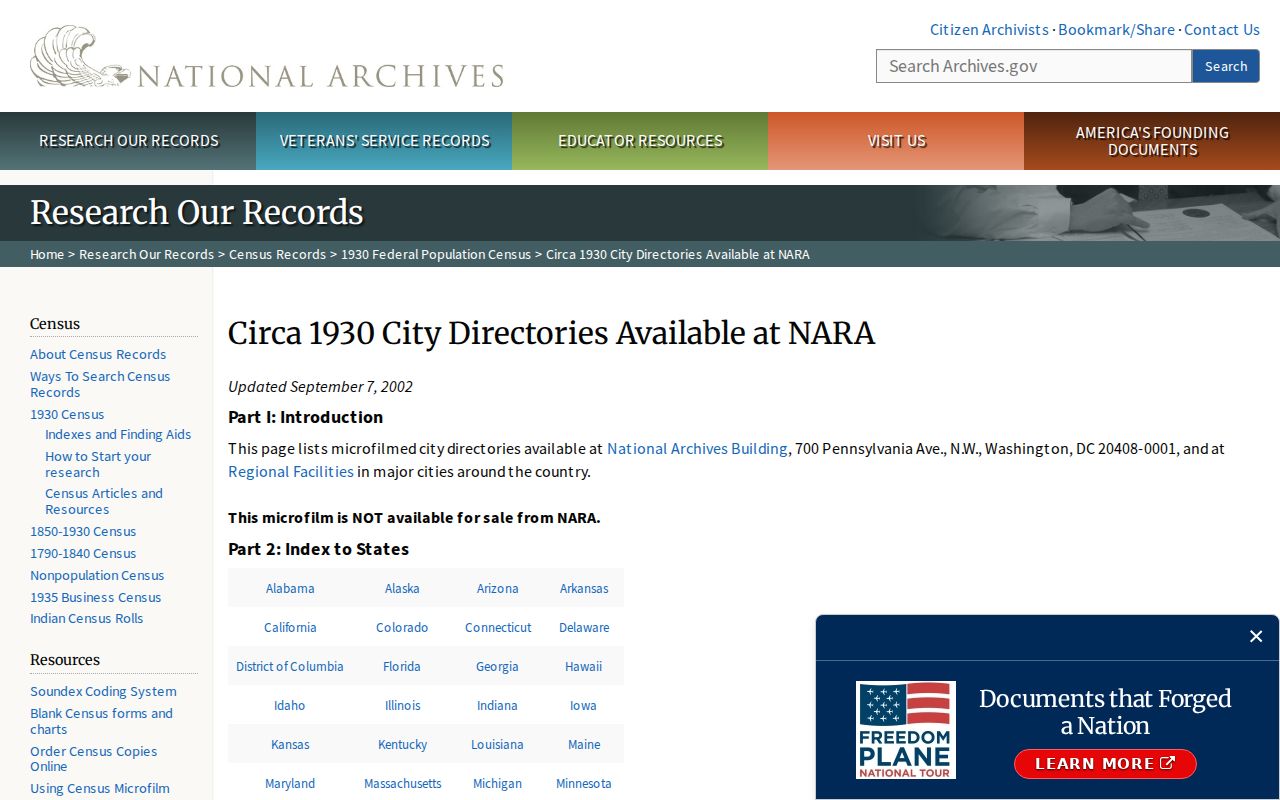
The archive image underscores the gap caveat: a county volume can contain Newport Beach without being labeled only with the city name.
Newspapers and digitized databases can supply the bridge when a directory volume is not accessible. Search a surname, address in quotation marks, neighborhood name, business line, spouse, or relative. Preserve the publication date and page or result details so a database hit remains traceable to its source.
Newport Beach Databases Fill Directory Gaps
The Newport Beach Public Library databases page lists in-library Ancestry Library Edition, HeritageQuest, NewsBank, Orange County Register and Daily Pilot access, and Los Angeles Times Historical. These sources can add census households, obituaries, local news, and historical context when a city directory sample skips a year. State Library, Orange County Public Library, and FamilySearch resources add further genealogy routes noted in the research.
Newport Beach Public Library databases identify the library-access conditions and the newspaper and genealogy tools. A library card or in-library session may be needed. Search by address in quotation marks, surname plus locality, business name, spouse, or relative, then check the original issue or index context.
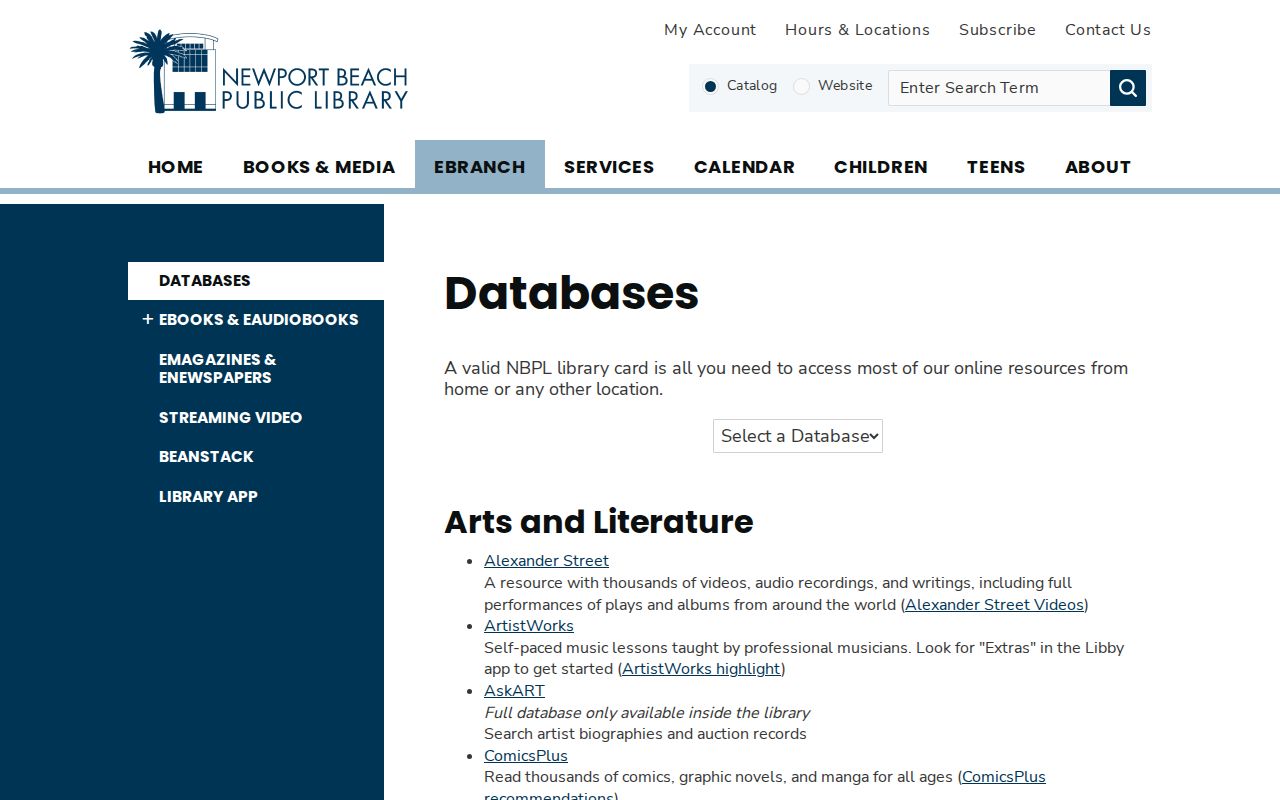
The database image fits the gap-filling workflow: a newspaper or census result can test a directory clue, but it should not be presented as the directory volume itself.
When a directory entry needs a modern identity check, the Newport Beach resident lookup can compare official records and source limits without treating a historical listing as current proof.
Sanborn and Sherman Collections Add Context
The May 1922 Sanborn map has nine sheets for Newport Beach, Balboa, and East Newport. It shows building footprints, uses, and street layout, making it a visual check on an old address. Use a lot line, nearby feature, street label, and directory entry together. A map can support a structure history, but it does not provide a household roster.
Sherman Library’s archival descriptions include Newport Beach City Marshal records from 1912-1924, fire record books from 1947-1955, police and fire scrapbooks, photographs, city reports, subject files, and vignettes on prominent residents. Balboa Island Museum and Newport Beach Historical Society add documents, photographs, and community history across Balboa, Corona del Mar, Newport Harbor, Back Bay, and Newport Coast.
These collections can reveal public officials, businesses, civic participants, and neighborhood events that a standard city directory omits. Finding aids and reference conditions matter. Use them as secondary evidence and retain the collection title, date, and access note beside every result.
Trace Family History Through Newport Beach Directories
A city directory becomes useful for family history when each year is treated as a dated observation. Start with a known name, address, or relative. Keep a small source log with publisher, locality, page, address, spouse mark, and the exact wording. A disappearing name may reflect a move, death, non-subscriber status, a changed index, or a missing volume.
- Find the first credible directory entry and copy its spelling, address, locality, and publisher.
- Follow the name forward and backward through nearby sample years, checking the reverse section when an address is known.
- Pair the closest directory years with 1920, 1930, 1940, or 1950 census households.
- Search local newspapers, obituaries, probate notices, yearbooks, or cemetery sources for a reason behind a change.
- Compare any property or court clue with its custodian and access limit before treating it as the same person.
The best result is a supported timeline, not a filled gap. Newport Beach’s localities, annexations, changing publishers, and discontinuous source run make exact citation more valuable than a smooth story.